Few political figures in modern Australia have sparked as much debate, controversy, and public reaction as Pauline Hanson. For some, she is a symbol of speaking “plain truths” ignored by political elites. For others, she represents division, fear-driven politics, and social regression. Regardless of where one stands, one fact remains undeniable: Pauline Hanson is one of the most influential and polarizing figures in Australian political history.
Understanding Pauline Hanson requires more than reading headlines or viral quotes. Her rise, fall, and repeated returns to the political spotlight reveal much about Australian society, voter frustration, nationalism, and the power of populist movements. This article explores what you need to know about Pauline Hanson—her background, political journey, ideology, controversies, and lasting impact.
Early Life and Unlikely Political Beginnings
Pauline Lee Hanson was born on May 27, 1954, in Brisbane, Queensland. Before politics, her life was far removed from parliamentary chambers and national debates. She worked various jobs, including running a fish-and-chip shop, and often presented herself as an “ordinary Australian” struggling with everyday concerns.
This background became central to her political identity. Unlike career politicians, Hanson positioned herself as someone who understood working-class frustrations firsthand. She spoke in plain language, avoided political jargon, and often rejected polished media appearances. This approach would later become both her greatest strength and her most criticized trait.
Her entry into politics was not carefully planned. Instead, it was abrupt, controversial, and explosive.
The Rise to National Attention
Pauline Hanson first entered the Australian Parliament in 1996 as an independent after being disendorsed by the Liberal Party due to controversial comments about immigration. Rather than ending her political career, this disendorsement became the catalyst for her rise.
Her maiden speech in Parliament ignited national controversy. In it, Hanson warned that Australia was being “swamped by Asians,” a statement that triggered widespread condemnation, protests, and international attention. Yet, for a significant segment of voters, her words resonated deeply.
She tapped into fears about globalization, immigration, economic insecurity, and cultural change—concerns that were growing but often underrepresented in mainstream politics at the time.
Almost overnight, Pauline Hanson became a household name.
The Formation of One Nation
In 1997, Hanson co-founded the political party One Nation, which quickly gained traction. The party positioned itself as anti-establishment, nationalist, and skeptical of multiculturalism and immigration policy.
One Nation’s platform focused on:
- Reducing immigration levels
- Opposing multiculturalism
- Emphasizing Australian identity and values
- Criticizing political elites and mainstream parties
- Advocating for regional and rural Australians
The party achieved surprising electoral success, particularly in Queensland, where it won multiple state seats. Hanson’s support base was strongest among voters who felt economically marginalized or culturally unheard.
However, rapid growth came with internal chaos.
Internal Conflicts and Legal Troubles
One Nation soon became synonymous with internal disputes, leadership battles, and organizational instability. Several party members resigned or were expelled amid infighting. The media closely followed these conflicts, often portraying the party as dysfunctional.
In 2003, Hanson’s political career took a dramatic turn when she was convicted of electoral fraud related to party registration. She was sentenced to prison, serving time before her conviction was later overturned on appeal.
For supporters, her imprisonment reinforced the belief that she was being targeted by the political establishment. For critics, it symbolized incompetence and misconduct. Either way, Hanson once again dominated headlines.
Political Comeback and Reinvention
Many assumed Pauline Hanson’s political career was over after her legal troubles. Instead, she staged one of the most remarkable comebacks in Australian politics.
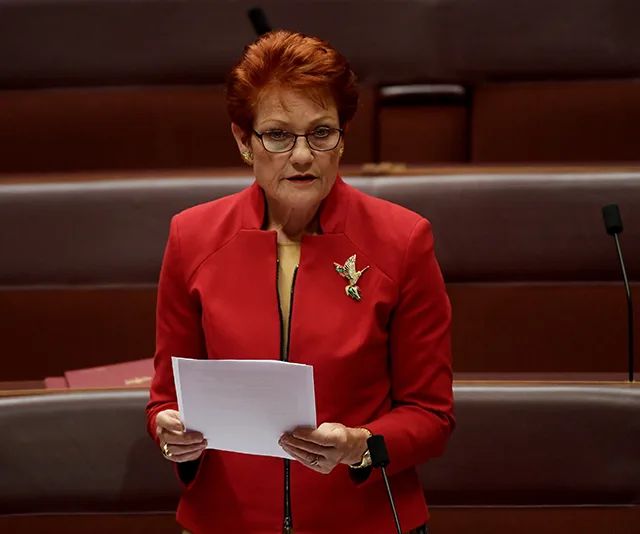
In 2016, Hanson returned to Parliament as a Senator for Queensland, marking a significant resurgence for One Nation. Her return coincided with global populist movements and growing skepticism toward traditional political institutions.
This time, Hanson appeared more strategic. While her rhetoric remained blunt, she demonstrated greater political discipline and media awareness. Her messaging focused heavily on:
- Immigration and border control
- Opposition to Islam in Australia
- National sovereignty
- Criticism of political correctness
Her re-election confirmed that her support base had not disappeared—it had evolved.
Controversies That Define Her Public Image
Pauline Hanson’s career has been shaped by controversy. Her statements on race, religion, and immigration have repeatedly sparked outrage and debate.
She has been widely criticized for comments about Islam, including calls for bans on Muslim immigration and symbolic gestures such as wearing a burqa in Parliament. While she defended such actions as political statements, critics accused her of promoting fear and division.
Hanson has also clashed with Indigenous leaders, environmental activists, and LGBTQ+ advocacy groups. Each controversy reinforced her reputation as a political lightning rod—someone who thrives in conflict and commands attention through provocation.
Yet, for her supporters, these moments are seen as proof of courage and authenticity.
Why People Support Pauline Hanson
Understanding Pauline Hanson requires understanding her supporters. Many voters who back her do not necessarily agree with every statement she makes. Instead, they are drawn to what she represents.
Common reasons for support include:
- Frustration with mainstream political parties
- Belief that political elites ignore ordinary Australians
- Concerns about immigration and cultural change
- Desire for blunt, unfiltered political speech
- Distrust of media narratives
Hanson’s appeal lies in her refusal to soften her language. In an era of carefully crafted political messaging, her raw delivery feels honest to those who feel unheard.
Criticism and Opposition
At the same time, Hanson faces intense criticism from across the political spectrum. Opponents argue that her rhetoric:
- Fuels racial and religious intolerance
- Oversimplifies complex social issues
- Encourages division rather than unity
- Undermines multicultural values
Academics and civil rights groups often point to the social consequences of populist rhetoric, warning that it normalizes discrimination and hostility. Critics argue that while Hanson claims to speak for “ordinary Australians,” her approach risks marginalizing vulnerable communities.
Media Presence and Communication Style
Pauline Hanson’s relationship with the media is both adversarial and strategic. She frequently accuses journalists of bias while simultaneously using media attention to amplify her message.
Her communication style is direct, repetitive, and emotionally charged—hallmarks of successful populist figures worldwide. She often frames issues as battles between “the people” and “the elites,” reinforcing a narrative of resistance.
This approach ensures visibility, even when public reaction is negative.
Her Impact on Australian Politics
Whether admired or condemned, Pauline Hanson has undeniably shaped Australian political discourse. She forced mainstream parties to confront topics they previously avoided and influenced national conversations on immigration, identity, and nationalism.
Some political analysts argue that her presence pushed major parties to toughen border policies and address voter dissatisfaction more directly. Others believe she lowered the tone of political debate and normalized extreme rhetoric.
Both interpretations highlight her influence.
Pauline Hanson Today
Today, Pauline Hanson remains a central figure in Australian politics. While One Nation’s electoral fortunes fluctuate, her ability to command attention has not diminished.
She continues to position herself as an outsider challenging the system, even after decades in politics. This contradiction—being both a veteran and an anti-establishment figure—is part of her enduring appeal.
Her political future remains uncertain, but her legacy is already firmly established.
Conclusion: A Figure Who Refuses to Fade
Pauline Hanson is not a politician who inspires indifference. She provokes strong reactions because she speaks to deep anxieties, unresolved tensions, and competing visions of what Australia should be.
To understand her is to understand a broader political phenomenon—one driven by fear, frustration, identity, and the demand to be heard. Whether history judges her as a necessary disruptor or a divisive force, her role in shaping modern Australian politics cannot be ignored.
Knowing Pauline Hanson means grappling with uncomfortable questions about democracy, representation, and the power of words. And that, perhaps, is why her story continues to matter.